
The Hidden Cost of Training Workers on Live Equipment: Can VR Reduce the Risk?
Training someone to operate a forklift, boom lift, scissor lift or crane seems straightforward.
Give them the theory. Show them the equipment. Put them under the supervision of an experienced trainer. Let them practise until they are ready.
But there is a cost hidden inside that last step.
Every hour of practice requires access to real equipment, a suitable training area, trainer availability and operational coordination. More importantly, a new operator is learning on an asset that can tip, collide, drop a load or put nearby workers at risk if something goes wrong.
So the real question for safety and training leaders is not whether practical training is necessary.
It is this:
How much of the learning curve really needs to happen on live equipment?
The Training Paradox in High-Risk Equipment Operations
Operators cannot learn equipment handling from a presentation alone.
They need to understand controls, movement, visibility, load behaviour, spatial awareness and how the equipment responds when conditions change.
For forklift operators, for example, OSHA requires a combination of formal instruction, practical training and workplace performance evaluation. Training is expected to address factors such as vehicle stability, load manipulation, pedestrian traffic, narrow aisles, ramps and workplace-specific hazards.
Boom lifts introduce a different set of risks. OSHA identifies falls, tip-overs, ejection, electrocution, entanglement and collisions with overhead objects among the hazards associated with aerial lifts. Operators must be trained to recognize hazards and demonstrate the skills needed to operate the equipment.
Practical experience clearly matters.
The challenge is that inexperienced workers need practice precisely because they are inexperienced.
That creates a difficult situation for training managers: workers need room to make mistakes while learning, but mistakes on industrial equipment may have real consequences.
4 Hidden Costs of Training on Live Equipment
1. Equipment Downtime
When a forklift, boom lift, scissor lift or crane is being used for training, it may not be available for productive work. The more operators you need to train, the more equipment time you need to allocate.
2. Trainer Time
Live training requires experienced trainers to supervise operators closely. Scaling training across more employees, shifts or locations means more trainer hours and more scheduling.
3. Repetitive Practice
New operators need repetition to become confident with controls, movement, positioning and load handling. When every practice attempt requires a real machine, those training hours quickly add up.
4. Training Mistakes
Mistakes are part of learning, but mistakes on live equipment can mean equipment damage, safety risks or operational disruption. Trainers also cannot safely recreate many dangerous situations simply to teach operators how to respond.
Where Spatio's Ready-to-Deploy VR Training Fits
The challenge is not to remove practical equipment training. It is to reduce how much basic learning, repetition and trial-and-error needs to happen on the actual machine.
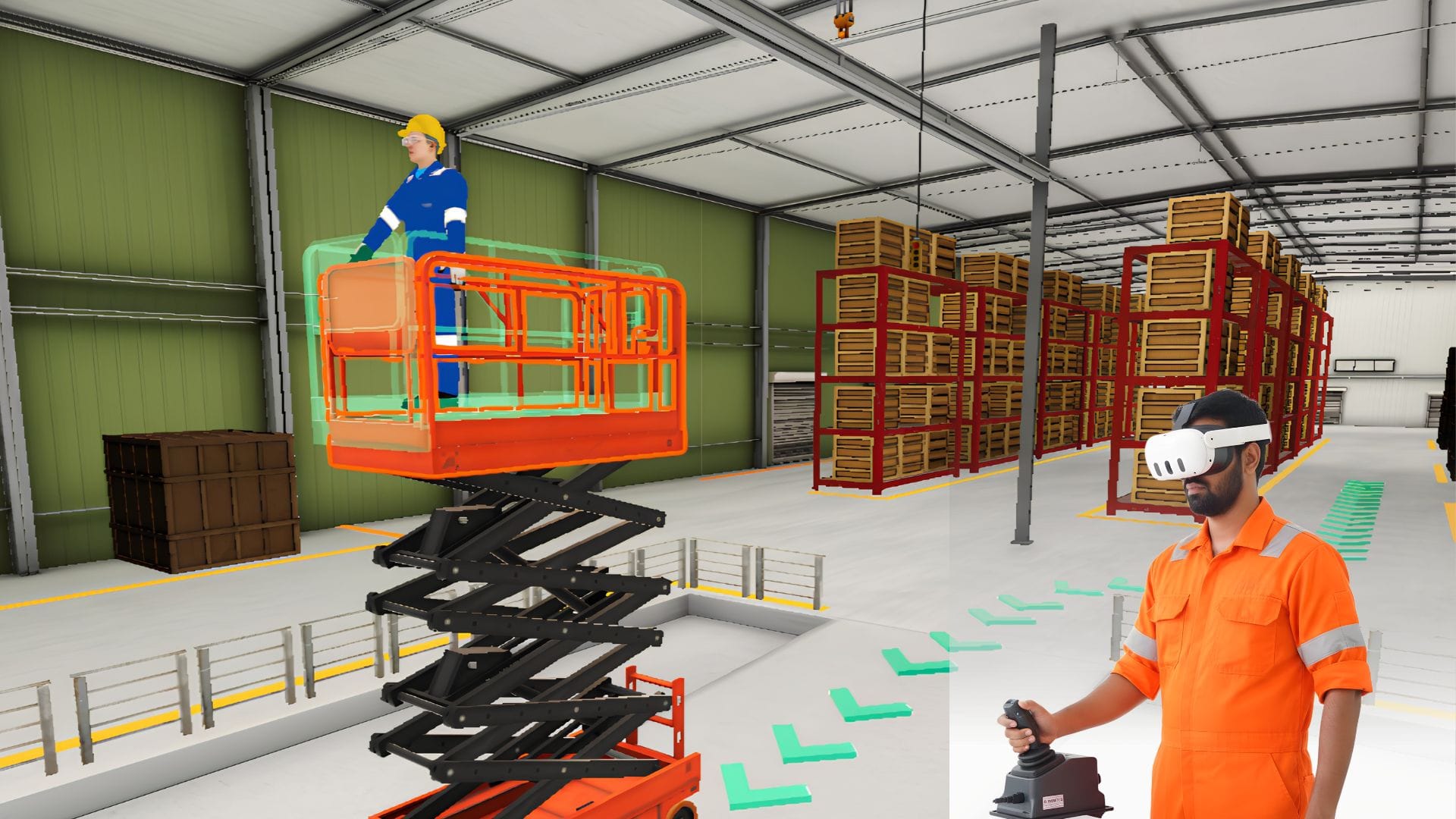
Spatio provides Ready-to-Deploy Industrial VR Training for equipment such as:
- Forklifts
- Scissor lifts
- Boom lifts
- EOT cranes
Operators can practise equipment handling, operating procedures and common workplace scenarios in a controlled virtual environment before progressing to supervised hands-on training.
This means companies can use VR for the repetitive learning stage while reserving live equipment for the practical experience and competency validation that actually requires the physical machine.
For organizations training operators across multiple shifts, facilities or locations, VR also creates a consistent training environment that can be deployed repeatedly without tying every practice session to equipment availability.
And because these modules are ready to deploy, organizations don’t have to begin with a lengthy custom VR development project.
VR Does Not Replace the Machine. It Changes When You Need It.
VR should not be positioned as a replacement for legally required practical instruction, supervised operation, certification or workplace evaluation.
Instead, it can reduce the amount of beginner-level learning that needs to happen on live equipment.
Traditional approach:
Learn → practise on live equipment → make beginner mistakes → repeat → evaluate
VR-supported approach:
Learn → practise virtually → repeat → practise on live equipment → evaluate
The machine remains an essential part of training.
But it doesn’t need to carry the entire learning curve.
A Better First Step Before Live Equipment
There will always be tasks that workers need to perform on real equipment before they are considered competent.
The opportunity is to make sure their first encounter with the real machine isn’t also their first opportunity to practise every decision.
With ready-to-deploy VR training, organizations can move more of the early learning and repetition away from live equipment while keeping real-world practical training where it belongs.
Use live equipment for real-world experience and competency.
Use VR to prepare workers before they get there.



Related Posts