
Can VR Actually Teach Equipment Operating Skills? A Warehouse Perspective
Walk into a modern U.S. warehouse and the job is far more physical and equipment-dependent than the word “warehouse” suggests.
Forklifts move pallets through active aisles. Scissor lifts take workers overhead. Articulating boom lifts require operators to think about movement in three dimensions. Around them are racks, docks, pedestrians, conveyors, inventory and other equipment competing for space.
Training people to operate these machines creates an obvious contradiction:
Operators need experience to become competent. But gaining that experience on real equipment can introduce risk before they are competent.
This is where Virtual Reality has an interesting role to play.
Not as a replacement for hands-on training.
But potentially as the missing layer between knowing how equipment works and being ready to operate it in the real world.
The Real Equipment Training Problem Isn't Knowledge. It's Experience.
Traditional equipment training often does a good job of explaining rules.
Operators can learn load capacity, inspection procedures, stability principles, fall hazards, operating limits and safe practices through classroom instruction, videos and digital courses.
But knowing the rule is different from executing it.
Consider a new forklift operator approaching a blind intersection.
They need to manage speed, steering, visibility, pedestrians, load position and surrounding traffic almost simultaneously.
Or consider an articulating boom lift operator positioning a platform around warehouse infrastructure. Operating the controls is only part of the task. The operator must understand how one movement changes the position of the entire machine relative to surrounding objects.
These are spatial and procedural skills.
They improve through practice.
And that is precisely where simulation becomes interesting.
What VR Changes: Mistakes Become Training Opportunities
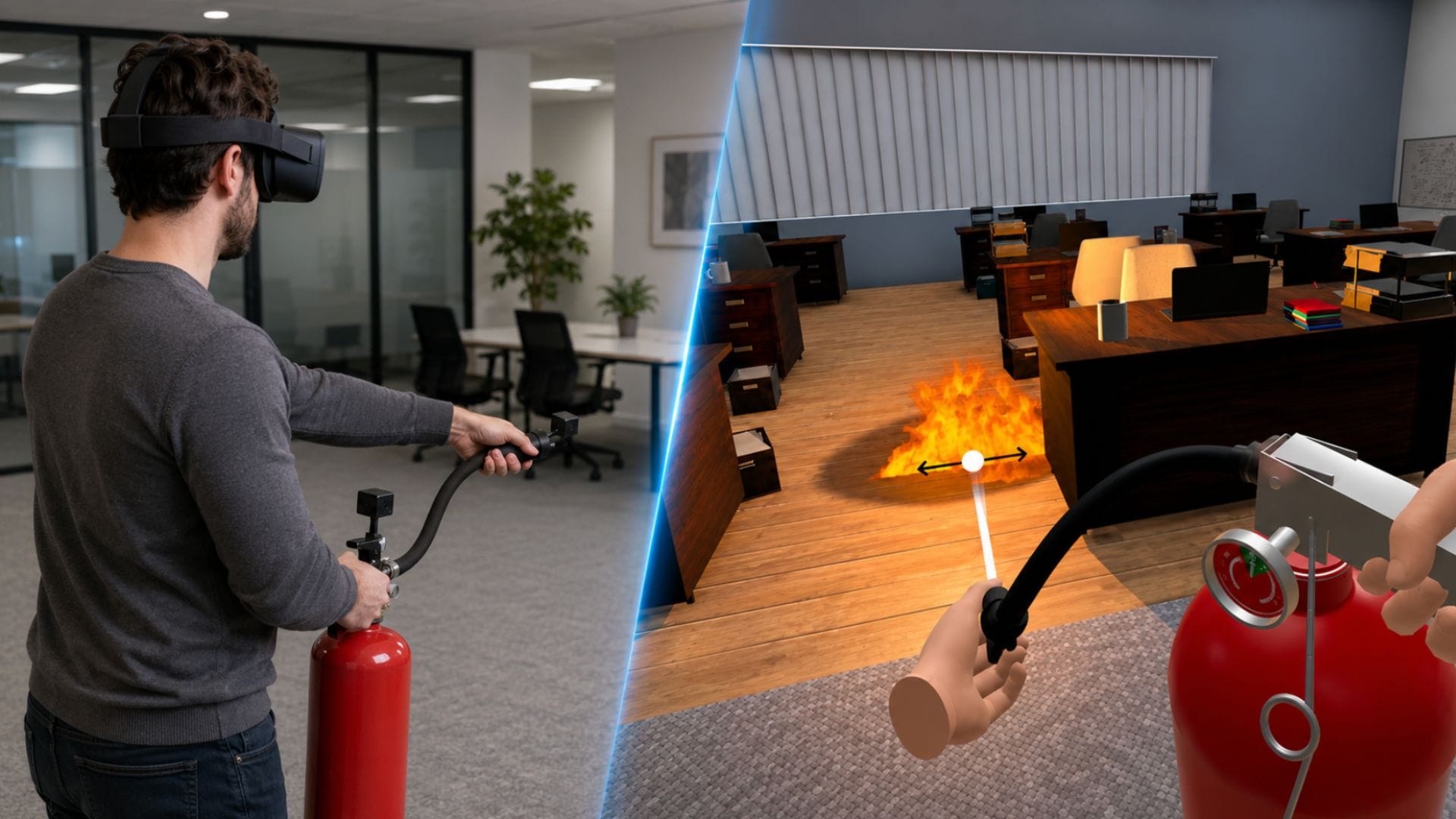
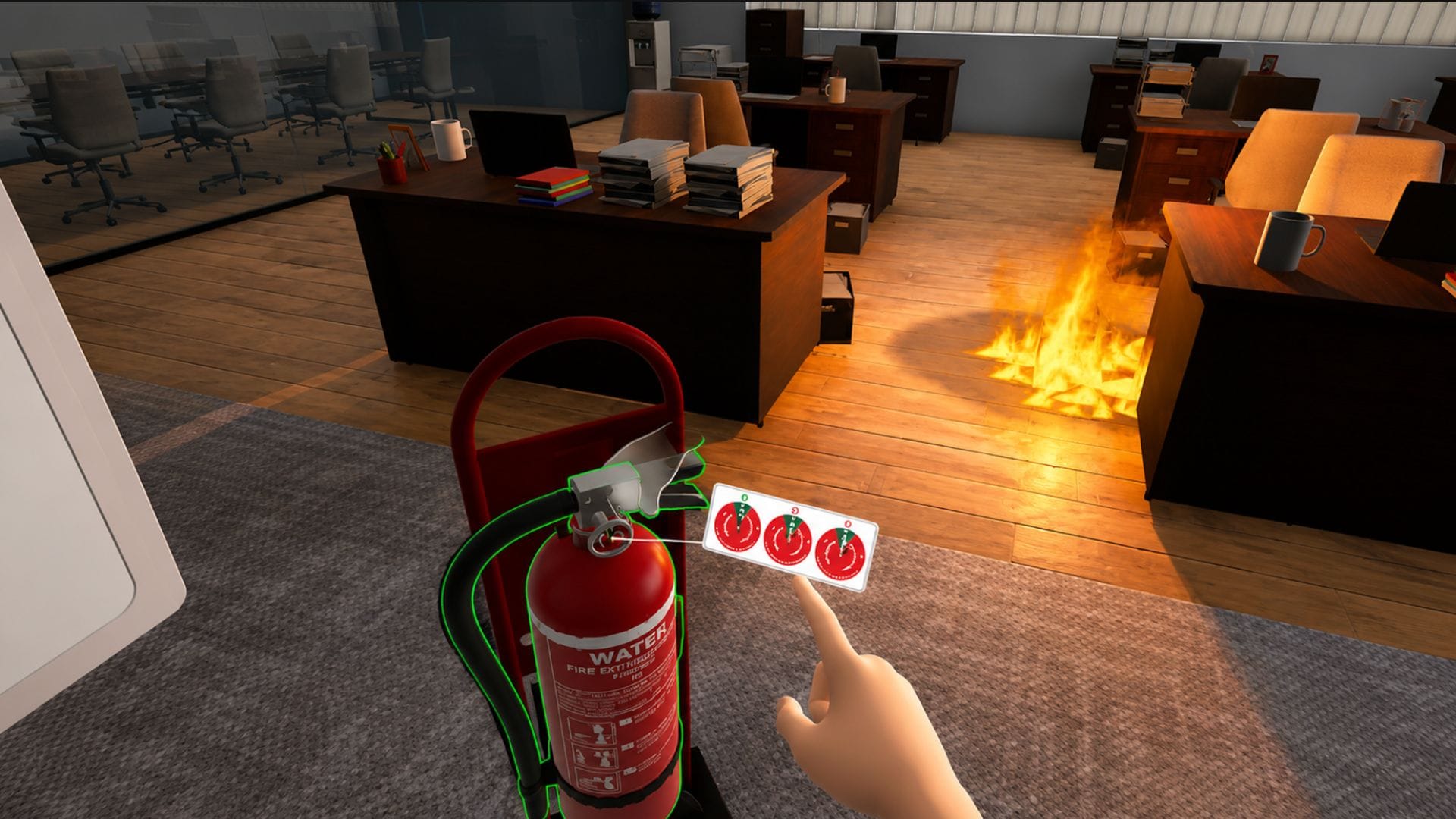
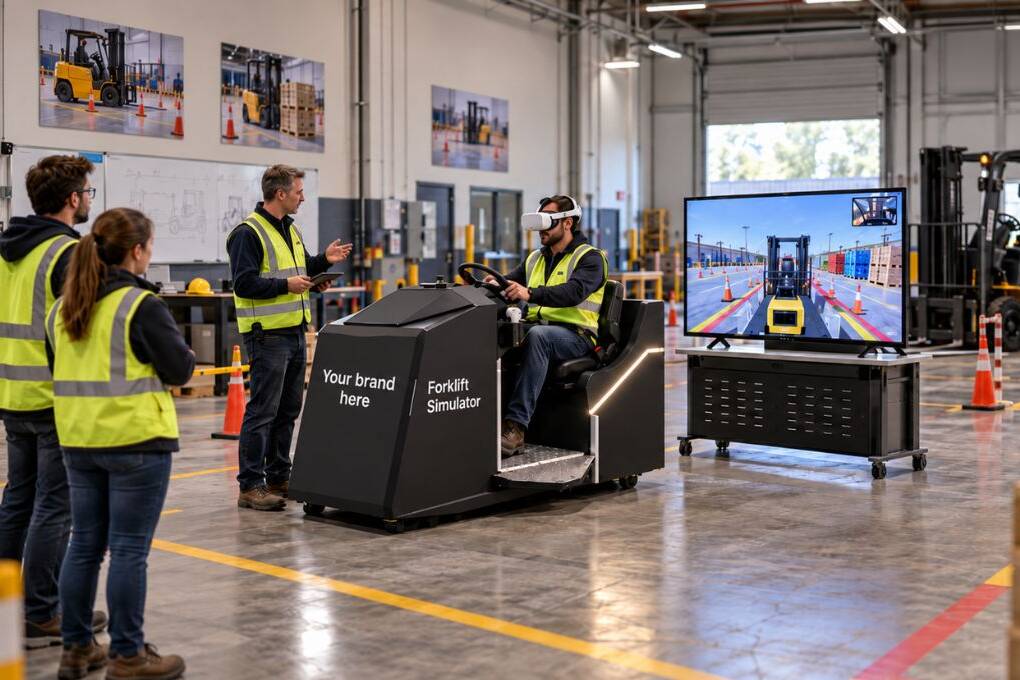
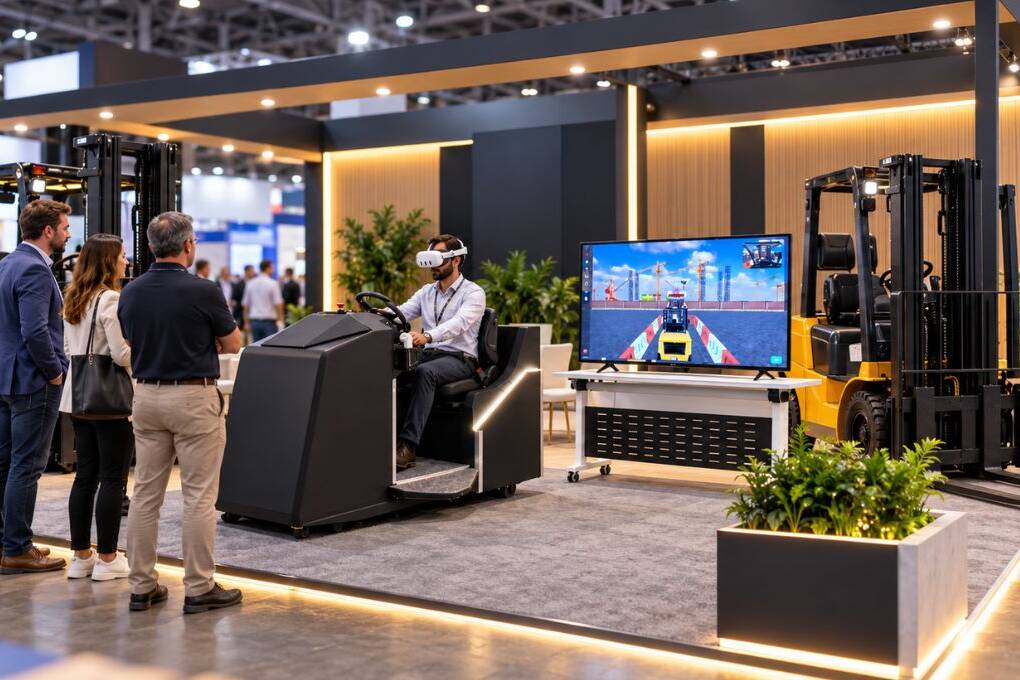
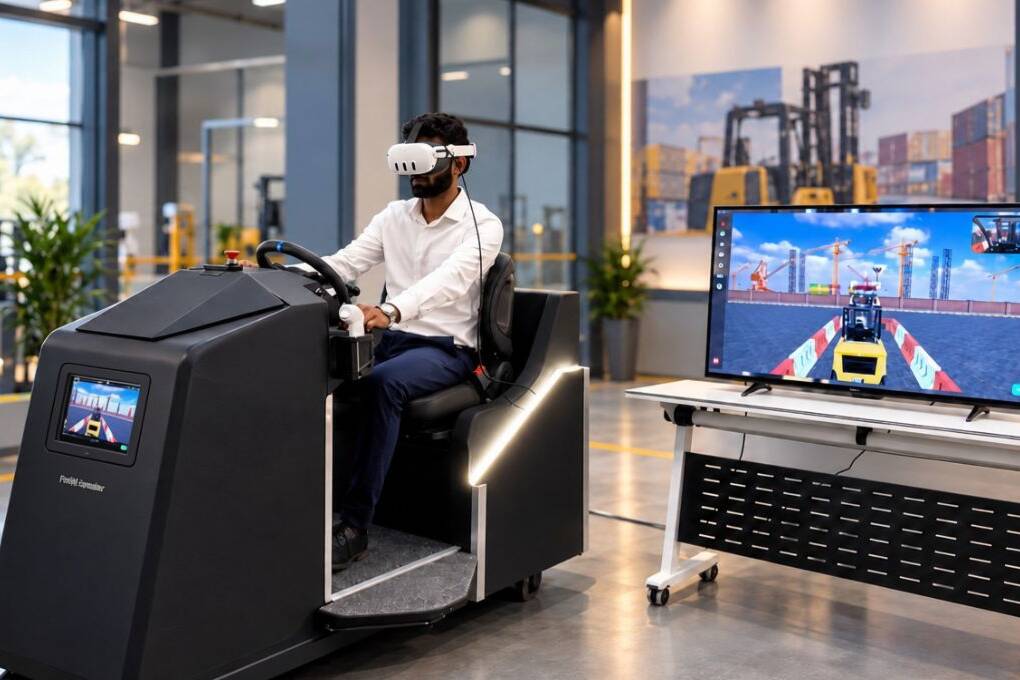
A physical equipment simulator combined with VR changes the learning experience significantly.
The operator isn’t simply wearing a headset and clicking buttons.
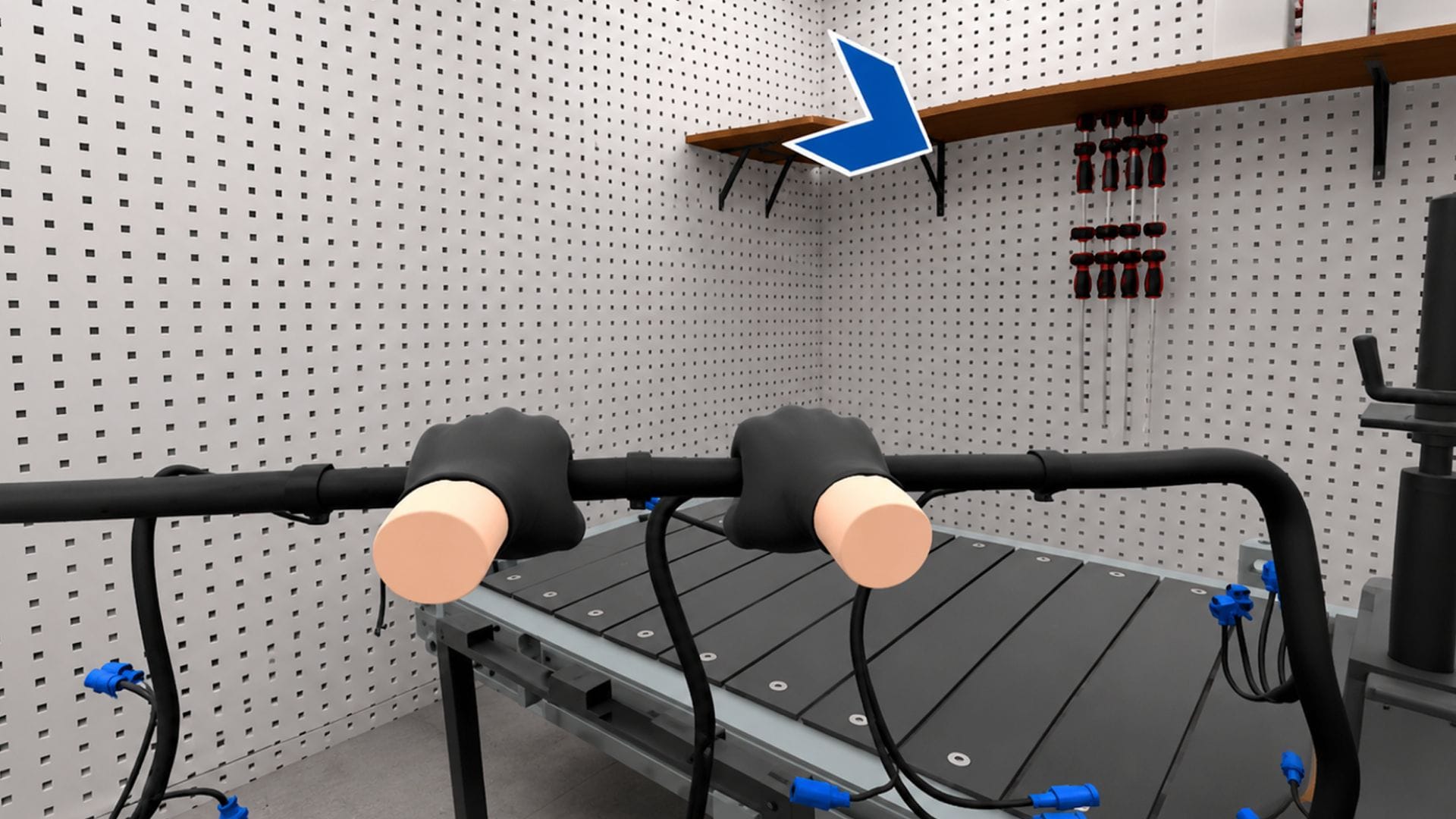
Imagine a forklift simulator with physical steering, pedals and hydraulic controls connected to a virtual forklift.
Turn the wheel and the virtual forklift turns.
Accelerate and it moves.
Raise the forks incorrectly and the consequences become visible.
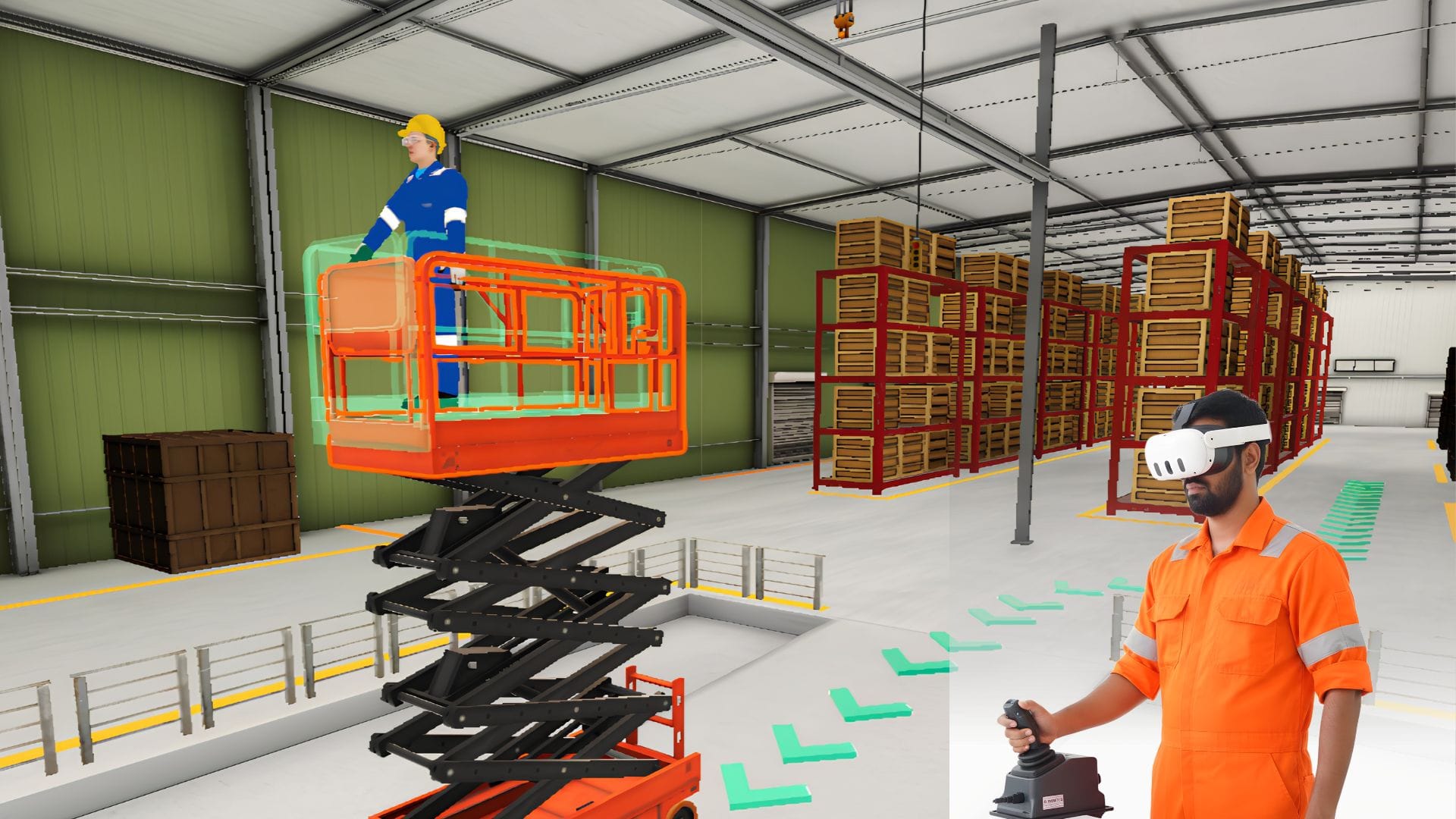
The same principle can be applied to equipment such as scissor lifts and articulating boom lifts, with physical controls driving a simulated machine inside an immersive warehouse environment.
Now the organization can introduce situations that would be difficult, disruptive or unsafe to deliberately recreate during early-stage training.
- A pedestrian steps into the aisle.
- A forklift approaches a blind corner.
- The operator attempts a turn with an elevated load.
- A boom approaches an overhead obstruction.
- A scissor lift is positioned incorrectly for the task.
The trainee can make the wrong decision, see what happens, receive feedback and try again.
Failure becomes repeatable without making the warehouse itself the classroom.
Forklifts: Probably the Strongest Case for VR Simulation
Forklifts are a particularly compelling application because warehouse operation depends heavily on spatial judgment.
OSHA requires powered industrial truck training to address not just the truck, but workplace conditions including pedestrian traffic, narrow aisles, ramps, restricted spaces and other potentially hazardous conditions.
That is important.
A forklift operator isn’t simply learning how to drive a forklift.
They are learning how to operate one inside a particular environment.
- VR can simulate scenarios around:
- Picking and placing loads
- Stacking at different heights
- Narrow-aisle maneuvering
- Blind intersections
- Load visibility
- Traveling with loads
- Hazard recognition
- Pre-operation procedures
More importantly, these scenarios can become progressively difficult.
Instead of giving every trainee the same amount of seat time, simulation can identify who is struggling with specific skills and provide additional practice.
What About Scissor Lifts and Articulating Boom Lifts?
This is where simulation becomes even more interesting.
Operating an elevated work platform involves understanding space above the operator as well as around the machine.
An articulating boom introduces another layer of complexity because operators need to understand how boom extension, elevation and articulation affect platform movement.
OSHA identifies hazards associated with aerial lifts including falls, tip-overs, ejections, entanglement, electrical contact and collisions with ceilings or other overhead objects. It also states that workers need training in correct operation and demonstrations of the skills and knowledge required to operate an aerial lift.
Scissor lifts introduce their own considerations, including positioning, stabilization, overhead hazards, load limits and safe movement. OSHA emphasizes training workers in correct operating procedures and the worksite hazards they may encounter.
These are situations where a simulator can provide something valuable:
repetition.
A trainee doesn’t have to perform an unfamiliar maneuver once and move on.
They can repeat it until the sequence becomes familiar.
But Can VR Really Create Equipment-Operating Skill?
This is where enterprises should be careful with the claims they make.
VR can help develop several components of equipment competence:
Control familiarity.
Operators can learn what controls do and build familiarity with operating sequences.
Procedural memory.
Inspection, startup, maneuvering and task sequences can be practiced repeatedly.
Spatial awareness.
Trainees experience clearances, turning behavior, elevated positioning and surrounding hazards from an operator’s perspective.
Hazard recognition.
Organizations can deliberately introduce hazards that trainees may encounter only occasionally during conventional training.
Decision-making under pressure.
Scenarios can require operators to react to changing conditions rather than simply memorize procedures.
But VR still has limitations.
Simulation cannot perfectly reproduce every physical characteristic of a real machine: vibration, resistance, load movement, hydraulic response, tire behavior, surface conditions and the psychological awareness that comes from controlling several thousand pounds of actual equipment.
And that distinction matters.
VR Shouldn't Replace Hands-On Training. It Should Make Hands-On Training Better.
For U.S. employers, this is more than a philosophical distinction.
For powered industrial trucks, OSHA requires training to include formal instruction, practical training and evaluation of the operator’s performance in the workplace. Employers must determine that an operator is competent before allowing independent operation, and operators must be evaluated at least once every three years.
Similarly, OSHA guidance for aerial and scissor lifts emphasizes trained operators and demonstrations of safe operating capability.
So the strongest enterprise model isn’t:
VR instead of real equipment.
It is:
Knowledge → Simulation → Supervised Equipment Practice → Workplace Evaluation
That changes the role of the simulator.
The simulator becomes the environment where operators can make their first 20 mistakes, rather than making those mistakes around racks, inventory, equipment and coworkers.
The Future of Warehouse Equipment Training Is Probably Hybrid
VR will not eliminate forklifts from forklift training.
Nor should it.
But expecting every part of equipment competence to develop only after an employee climbs onto the actual machine is increasingly difficult to justify when simulation can provide a controlled environment for practice.
The more useful question for U.S. warehouse leaders is therefore not:
“Can VR replace equipment training?”
It can’t, and in important cases regulatory requirements mean it shouldn’t.
The better question is:
“How much skill can we build before the employee ever touches the real machine?”
For forklifts, scissor lifts, articulating boom lifts and potentially other warehouse equipment, that may become one of the more important questions in the next generation of workforce training.