
Off-the-Shelf vs. Custom Forklift Simulator: Which Is Right for Your Warehouse?
Forklift training has an unusual challenge.
You want operators to build hands-on skills. But letting an inexperienced operator learn through mistakes inside a busy warehouse is hardly an ideal training strategy.
That is where VR forklift simulators can help.
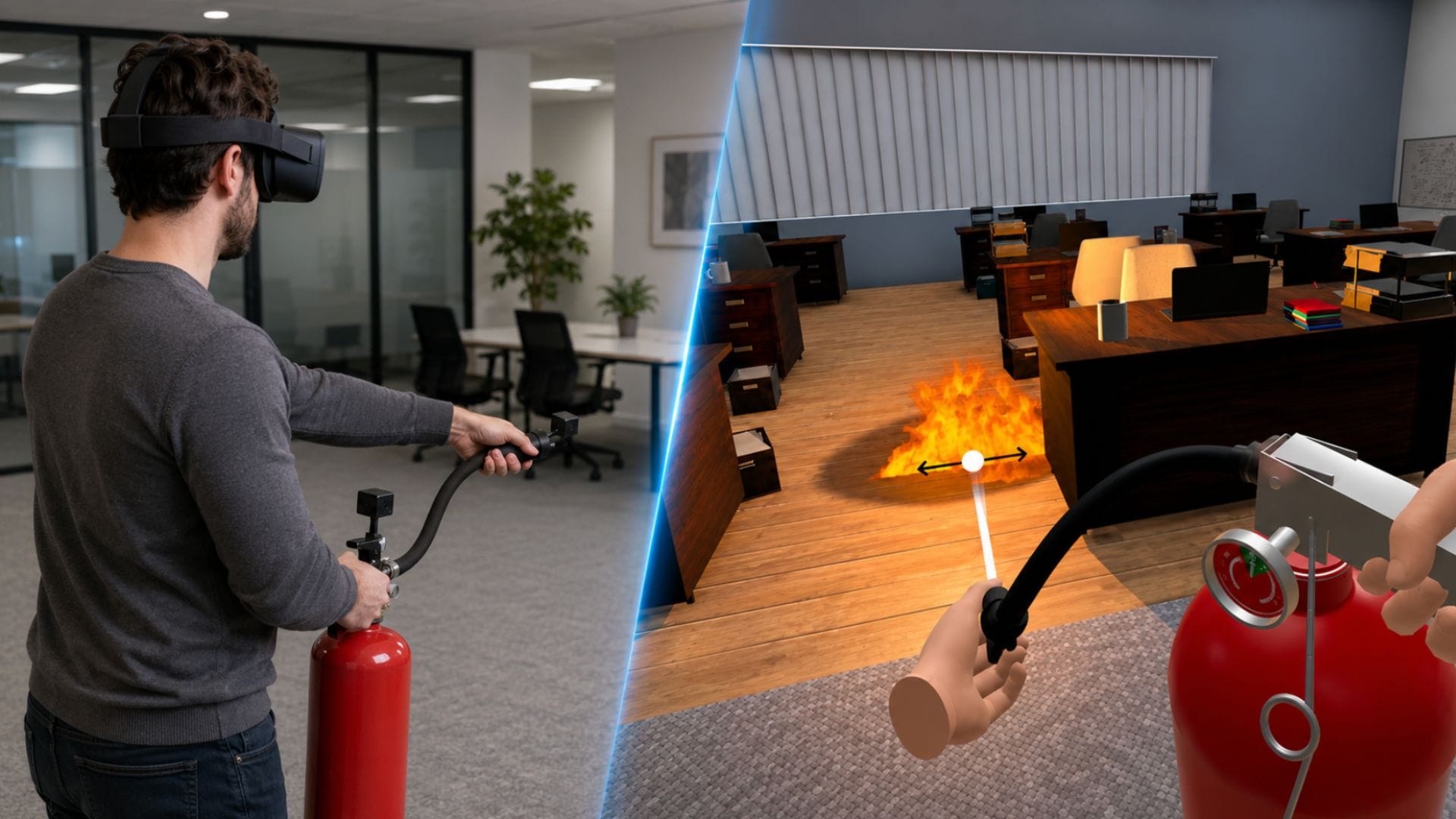
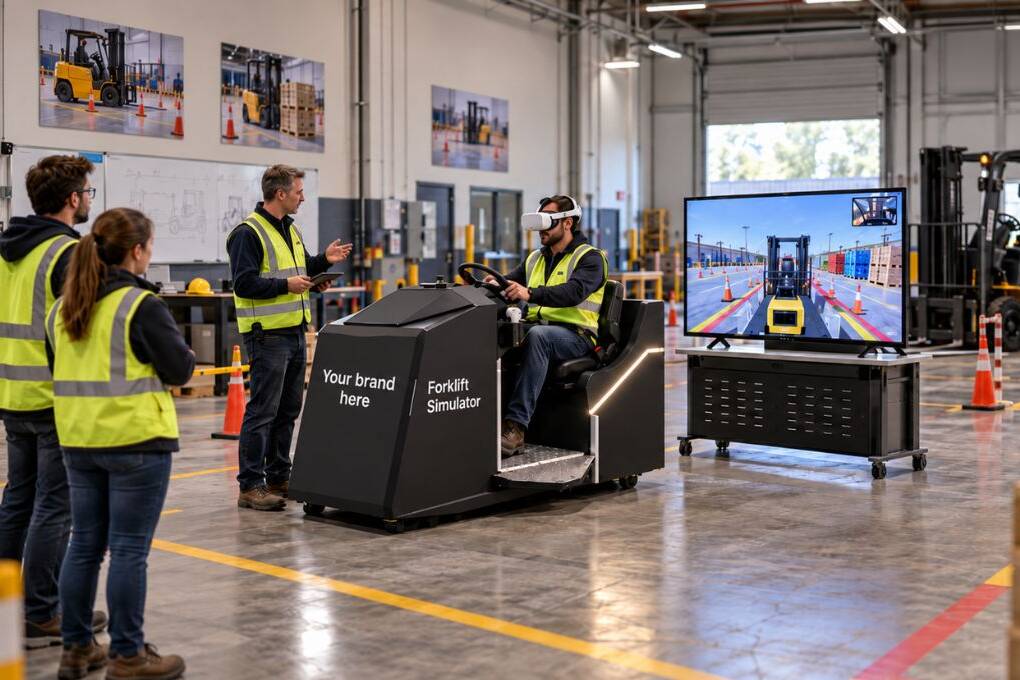
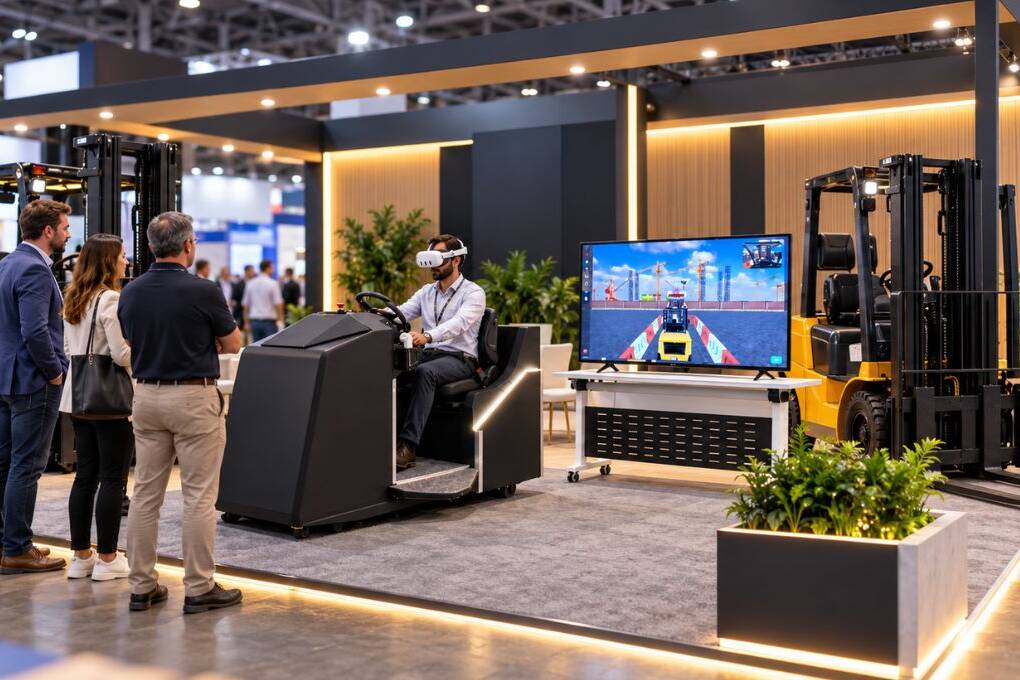
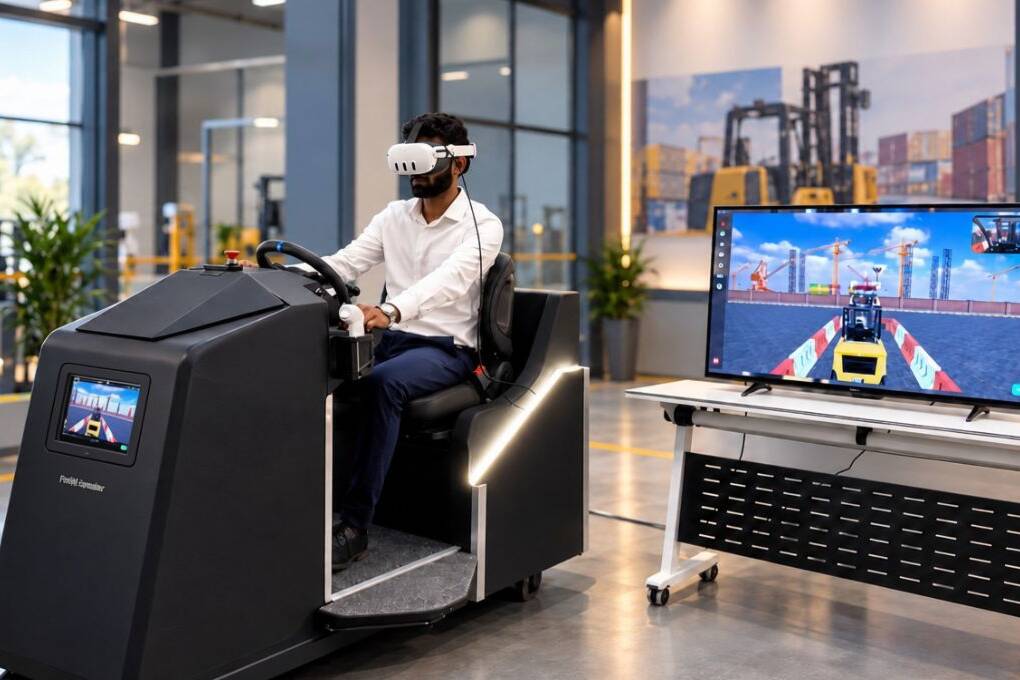
Modern forklift simulation can combine a physical operator station, including steering, pedals and controls, with a VR environment where the operator drives and handles a virtual forklift.
Trainees can practice maneuvering, load handling and hazard recognition without putting people, inventory or operating equipment at risk.
But once a warehouse decides to invest in simulation, another question appears:
Should you buy an off-the-shelf forklift simulator or develop one around your actual operation?
The answer depends on what you are trying to achieve.
First, What Is a VR Forklift Simulator?
A VR forklift simulator connects physical forklift controls with a virtual forklift and warehouse environment.
Instead of learning with a keyboard or standard VR controllers, the trainee physically steers, accelerates, brakes and operates lifting controls while seeing the consequences of those actions inside VR.
Both off-the-shelf and custom-developed solutions can use this approach.
The difference is primarily in what happens inside the simulation and how closely it represents the equipment, tasks, hazards and operating conditions employees encounter at work.
Off-the-Shelf Forklift Simulators: Faster Route to Fundamental Skills
An off-the-shelf forklift simulator is typically built around common forklift operations and standardized warehouse environments.
Think of it as buying a training system that is already designed, tested and ready for deployment.
Operators might practice:
- Steering and maneuvering
- Fork positioning
- Picking and placing pallets
- Stacking and unstacking
- Driving with loads
- Basic stability principles
- Pedestrian awareness
- Common warehouse hazards
Where Off-the-Shelf Simulators Win
1. Faster deployment
There is little need to model your warehouse or build operational scenarios from scratch. For organizations looking to introduce simulation quickly, this can significantly shorten implementation time.
2. Lower initial investment
Development costs are distributed across a standardized product rather than being absorbed by one enterprise.
3. Good for foundational training
If the objective is teaching basic forklift control and safe operating behaviors, a generic warehouse may be perfectly adequate.
4. Easier multi-site standardization
A company operating numerous distribution centers can deploy the same training experience across locations.
Where They Start to Fall Short
A generic warehouse is still a generic warehouse.
It may not reproduce your aisle widths, rack configuration, loading docks, pedestrian routes, equipment characteristics or operating procedures.
That matters because U.S. forklift training requirements aren’t concerned only with generic driving skills.
OSHA requires powered industrial truck training to address both truck-related and workplace-related topics, including pedestrian traffic, narrow aisles, ramps, hazardous locations and other conditions that affect safe operation.
So an off-the-shelf simulator can be valuable, but enterprises should avoid treating simulation alone as complete OSHA operator certification. OSHA requires a combination of formal instruction, practical training and an evaluation of operator performance in the workplace.
Custom Forklift Simulators: When the Warehouse Becomes Part of the Training
Now imagine something different.
Instead of entering a virtual warehouse, the operator enters your warehouse.
The racks are positioned where employees expect them. The loading dock looks familiar. Pedestrian crossings appear in the correct locations. The virtual forklift can be configured around the equipment category being trained. Even operating scenarios can reflect tasks employees actually perform.
This changes the purpose of simulation from:
“Can this employee operate a forklift?”
to:
“Can this employee safely perform this forklift task under the conditions we actually operate in?”
Where Custom Simulation Wins
1. Site-specific hazard training
Enterprises can recreate blind intersections, narrow aisles, loading zones, ramps, pedestrian interactions and other site-specific risks.
2. Equipment-specific familiarity
Controls, handling characteristics and training scenarios can be developed around the relevant truck type and operating application.
That is particularly useful because OSHA specifically requires training applicable to the type of powered industrial truck the employee will operate.
3. Training for high-risk situations without creating the risk
Want an operator to experience a pedestrian suddenly entering an aisle?
An unstable load?
Poor visibility?
A difficult loading-dock maneuver?
Simulation allows those events to be introduced repeatedly without deliberately creating dangerous situations on the warehouse floor.
4. Better assessment possibilities
A custom system can potentially capture metrics such as collisions, unsafe speeds, incorrect fork height, load-handling errors, missed observations or procedural mistakes.
Instead of simply recording that an employee completed a module, enterprises can identify where operators are struggling.
The Trade-Off
Customization takes work.
The warehouse may need to be digitally recreated. Forklift behavior needs to be configured. Scenarios, scoring logic and hardware integration need development and validation.
That means a custom solution generally requires more implementation time and a higher upfront investment than an off-the-shelf simulator.
For a small operation requiring only basic forklift familiarization, that investment may be difficult to justify.
For a large distribution network with recurring operator training, site-specific risks and standardized operating procedures, the calculation can look very different.
Off-the-Shelf vs. Custom Forklift Simulator: Quick Comparison
| Consideration | Off-the-Shelf | Custom Developed |
| Deployment speed | Faster | Longer implementation |
| Initial investment | Generally lower | Generally higher |
| Basic forklift skills | Strong fit | Strong fit |
| Warehouse-specific environment | Limited | Can replicate actual facility |
| Site-specific hazards | Limited | Highly configurable |
| Equipment/task customization | Limited to available options | Can be developed around requirements |
| Enterprise assessment | Standardized metrics | Custom KPIs and scoring possible |
| Best suited for | General skills and rapid rollout | Site-specific operational training |
So, Which Forklift Simulator Should You Choose?
Don’t begin with “Which simulator has more features?”
Begin with “What behavior are we trying to change?”
If you need to teach fundamental forklift operation across many workers quickly, an off-the-shelf simulator may deliver exactly what you need without unnecessary development.
If incidents, near misses or operational complexity are tied to conditions unique to your facilities, a custom simulator can turn those real operational risks into repeatable training scenarios.
One Important Point for U.S. Employers
VR should strengthen forklift training, not be positioned as a replacement for required workplace evaluation.
OSHA requires employers to ensure operators are competent, provide formal and practical training, and evaluate operator performance in the workplace. Operator performance must also be evaluated at least once every three years, with refresher training triggered by circumstances such as unsafe operation, accidents or near misses, assignment to a different truck type, or relevant workplace changes.
That actually makes VR particularly interesting as part of a broader training strategy.
Use simulation to practice difficult situations repeatedly.
Use the real workplace to demonstrate and evaluate actual operating competence.
The Bottom Line
The best forklift simulator isn’t necessarily the most customized one.
It is the one that matches the training problem.
For standardized skills, an off-the-shelf VR forklift simulator can provide a
faster and more economical path to simulation-based training.
For complex warehouses where facility layout, equipment, pedestrian movement and operating procedures materially influence risk, custom development can make training significantly more relevant to the job operators actually perform.
And for many large U.S. warehouse and distribution operations, the sweet spot may sit somewhere between the two: a proven simulator platform customized around the risks that matter most.
Before investing, ask one question:
Are you training someone to drive a forklift, or training them to operate your forklift safely in your warehouse?
The answer should shape the simulator you choose.